
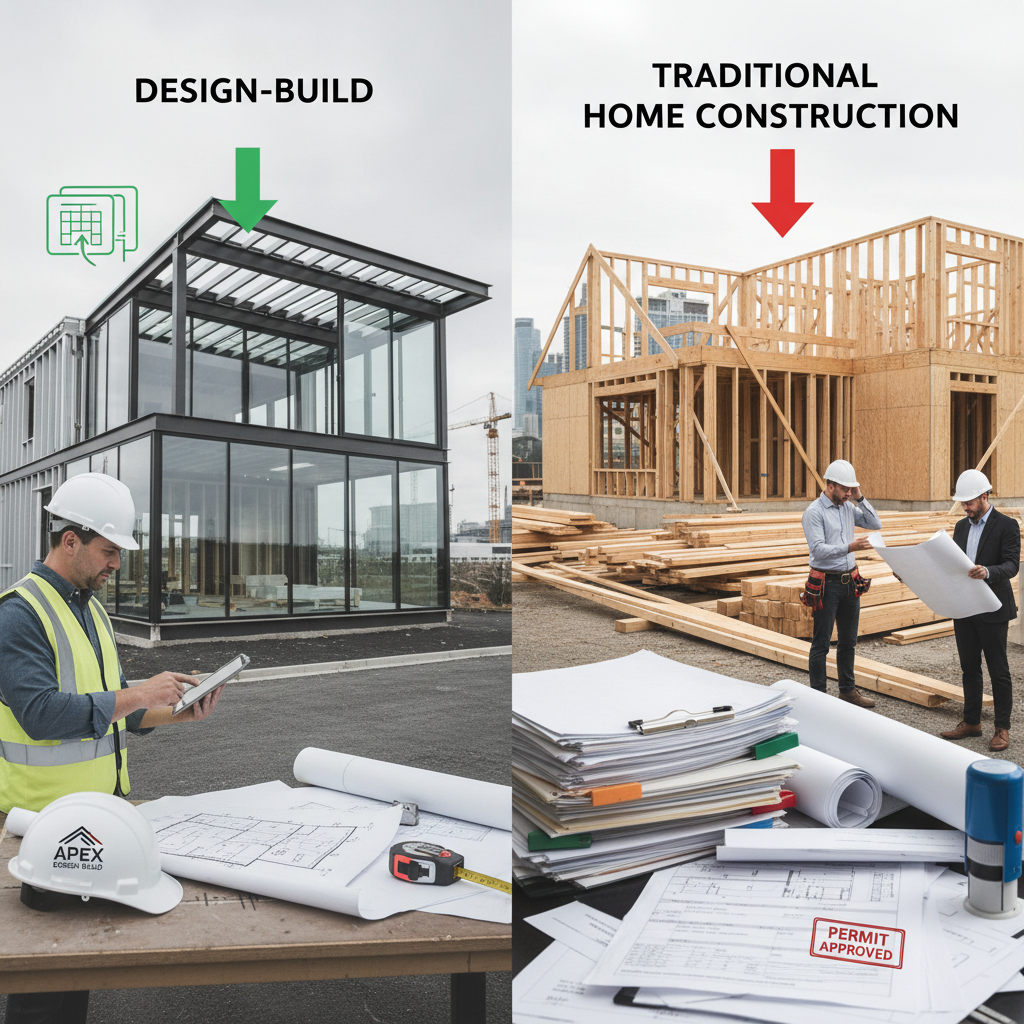
Most people start a home project thinking about paint colors, kitchen islands, and where the couch will go. Especially when planning something like a kitchen renovation in Toronto, homeowners often dream about it.
They don’t usually think about emails.
Or waiting.
Or figuring out who is responsible when something doesn’t match the drawing.
But that part, the process, is exactly why understanding design-build vs traditional home construction matters before you begin. The structure you choose won’t just decide how your house is built… it decides how smooth (or stressful) the journey feels.
Let’s break it down in a simple, real-life way.
First, What’s the actual difference?
When people compare design-build vs traditional construction, they’re really comparing how many people you hire and how they work together.
In the design-build construction method, one company handles everything, planning, drawings, budgeting, and construction. You share your ideas once, and the same team carries them through to the end.
In traditional home construction vs design-build, you hire an architect to design first, then a contractor to build. Both are professionals, but they work under separate agreements. That means information travels between them… often through you.
Both approaches can build a beautiful home.
But they feel very different while happening.
When Something Goes Wrong (Because Something Always Does)
This is where the biggest difference shows up in design-build vs traditional home construction.
Imagine a wall needs to move because of plumbing.
In design-build:
The team discusses it internally and fixes it.
In traditional construction:
The contractor asks the architect → the architect revises → approvals happen → work resumes.
Nobody is doing anything wrong, it’s just how the system works.
That’s why many homeowners researching traditional home construction vs design-build realize the real question isn’t construction quality… It’s coordination! Particularly in projects where several trades must work in perfect harmony, like kitchen renovations Mississauga residents do.
Let’s Talk About Money (Honestly)
During a design-build vs. traditional construction comparison, people often assume traditional is cheaper because they receive multiple bids.
At first, it can look that way.
But drawings are created before builders price real materials and real site conditions. So adjustments during construction turn into change orders. The total slowly climbs.
The design-build construction method approaches budgeting differently. The builder and designer plan together from the start, shaping the design around realistic costs. Instead of surprises later, you make decisions earlier.
This is why homeowners considering design-build construction pros and cons often say the final price feels more predictable, even if the initial estimate wasn’t the lowest.
Time: Where Projects Quietly Expand
With traditional construction, everything happens step-by-step:
design → bids → revisions → approvals → build.
If one step changes, several others pause.
With the design-build construction method, planning overlaps. Permits, materials, and scheduling move forward while design details are finalized.
So when comparing design-build vs. traditional home construction, the difference isn’t speed, it’s fewer idle weeks where nothing happens. Projects involving detailed spaces, such as high-end bathroom renovation ideas, benefit from fewer redesign stages.”
Creativity: Does One Limit Your Ideas?
A common fear during traditional home construction vs design-build research is losing creative freedom.
In reality, both allow creativity, just at different moments.
Traditional design:
You dream first, then adjust to the budget later.
Design-build:
You design while knowing what things actually cost.
When reviewing design-build construction pros and cons, many homeowners discover this prevents redesigning halfway through. Instead of removing features later, you refine them early.
This approach works well for homeowners interested in innovative remodeling for luxury homes because design and feasibility are developed together
Stress (The Part Nobody Puts in Brochures)
Construction is emotional. You’re making decisions about a place you’ll live in.
In traditional construction, communication passes through multiple channels, so you may coordinate more conversations.
In the design-build construction method, communication is centralized. Fewer phone calls. Fewer “let me check with them” moments.
That’s often why people comparing design-build vs traditional construction end up deciding based on peace of mind rather than technical differences.
So Which One Should You Choose?
There isn’t a universal winner in design-build vs traditional home construction, it depends on you.
Choose design-build if you want:
- One responsible team.
- Clearer budgeting.
- Fewer moving parts to manage
Choose traditional if you want:
- An independent architect first.
- Separate creative and construction control.
- Comfort coordinating multiple professionals.
Understanding design-build construction pros and cons helps you match the process to your personality, not just the project. And it’s something any homeowner should discuss with a home renovation company in Brampton or any contractor before starting.
The Simple Takeaway
Both methods can build the same house.
But they won’t feel the same while happening.
The real decision in design-build vs. traditional home construction isn’t just about walls and floors, it’s about how you want the months of construction to unfold in your daily life.
Because long after the paint dries, most homeowners remember one thing clearly:
Not the tile pattern.
Not the cabinet handles.
They remember whether the experience felt manageable… or overwhelming.